Showing posts with label cutting. Show all posts

Monday, June 6, 2016

Propogating Plantlets En Mass

It's been AWHILE since my last entry, for the purely simple reason that my gardening time has been taken up by my non-succulent plants! I think I will cave and post all gardening stuff up here. I'm just doing too well with the dahlias!

This photo spread is a look at the "nursery" I set up in my mini-greenhouse. Some of the plants are cuttings, some are plants developing from dropped leaves, and some are just little plants, like my baby butterfly kalanchoes that grew on the leftovers from my deadheading of the pink plants.

Wanted to show the spray bottle, because I've found it's by far the BEST way to water plantlets and small cuttings. I got the spray bottle at Daiso Japan, my favorite "dollar" store (most items are actually $1.50). I set it to mist and then I mist the hell out of the plants. I want it looking like a Stephen King flick, at least for a millisecond. I'm done when everybody's all shiny and the soil is dark.

Most of these little guys are what I call "self-starters" or "accidental" propagation. Once a month, or just when I'm weeding, I look for dropped leaves that have started to grow into plants. Some succulents are so delicate the leaves just drop off when you brush them, so it's careful work to reach in and pick out the leaf with its plantlet and pink roots. I gotta be totally honest. I was at my parents' this weekend. I went through some of my mom's pots and stole her self-starters! Only five... besides, she container-gardens. No room for the plants to expand. I'm giving them life! Wink, wink. Emoji needed here.

If you take a look at this particular photo, you'll see that to the far right and center left are TWO BABY BUTTERFLY KALANCHOE PLANTS! These guys came from the leftover stems I had stuck in the dirt! They grew without leaves, so I popped them off their stems and after giving them a day or so to callous, set them in this wet, enriched soil. Weird thing; I've got three of the baby butterflies in here right now, and only the smallest one has developed roots at this point.

The aeonium above is the popular canariense variety, and is the last of about five cuttings I took the last time I "reorganized" that plot of plants. The other cuttings grew roots splendidly and have been popped in the ground with the rest of the succulent patch. Amazing to think they were cut off of plants that I bought originally at the size of the tiny cutting!

Sometimes you get strange growth. At the bottom center of the photo is a fuzzy little guy from my OTHER awesome kalanchoe, the fang plant. It's grown roots, but it doesn't seem to be developing a plant. It happens. Since it already has roots, I'm giving it a chance to turn into a "real" plant. This photo mostly contains ghost plant, jelly bean, and Fred Ives.

The Fred Ives plant has blown my mind. I bought one plant three years ago, and now I have at least ten fully-grown offshoot plants! An example of it is the orange-green rosette looking sideways at the center right. Fred Ives are one of those rainbow varieties, and while they aren't my FAVORITE, they are great to keep putting around the patch! Their plantlets grow REALLY weird, and always look wavy and wrong when tiny. I have two in my doll head pots right now. The other doll head has a ghost plant baby.

My original Fred Ives echeveria.
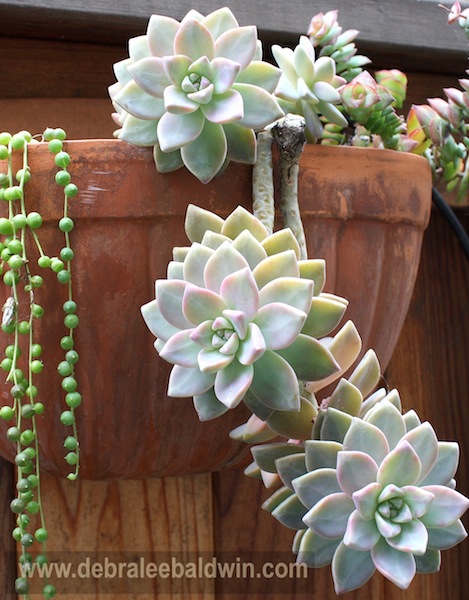
Here is a lovely ghost plant picture from the queen of succulents, Debra Lee Baldwin. Just look at those colors! Very excited about all my little ones!


Sunday, April 3, 2016

Closing the Circle (no, this is not a Wiccan thing)

Aeonium rosettes cut cleanly from the mother plant.
This morning I did a little plant trimming and moving to complete the circle of aeoniums around my agave marginita. I started by cutting aeonium rosettes, then found that I had a smaller plant I could pull out and replant, as well as a rosette that had rooted.
This plant could be pulled out of the circle without leaving a large gap.

This little guy had already formed its own roots, so was a perfect choice.


In the larger plant I pulled, you can see how the long, brown stem would stand out as rather ugly in less dense foliage. This is a reason to deadhead a plant, and you would cut the stem off cleanly as closely to the "head" as possible.

Closing the gap. You can see I left some space for the agave where I had trimmed off leaves.
 I dug holes and planted the two rooted plants in the gap where the Mexican feather grass bush had been. They nearly enclose the space as is, but in less than a year will be dense enough with new growth to complete an entire circle around the agave.
Planted and watered.

After I planted the rooted plants, I got lazy. Because the aeoniums grow so prolifically, I wasn't too worried about coddling the two cuttings I had made. I set them in place lightly on top of the soil after I watered it for the rooted plants. Hopefully, without too much intervention from me, they will naturally callus and create a root system for themselves. It's worked before; these aeoniums are tough suckers!

Cuttings placed lightly balanced on the other plants so they won't touch soil directly.
The small plant in front/in back of the agave and aeoniums needs me to do some research on it (it was a gift), but I'm hoping it will be a small tree.

Monday, May 27, 2013

Segway From Succulents: Hidden Mickey Cactus

When I first moved into my house my brother brought over a lot of plants he had literally pinched from larger plants and then grown from the cuttings. One of the pieces he brought over was a cactus, but I'd completely forgotten about it until finding it this morning while cleaning out a large planter where I'd had a large amount of ground cover choking the other plants.

This cute little guy is rotting away.


  After removing a very large patch of applejack, I found quite a few little plants that had been nearly overwhelmed by the dense groundcover. This cactus appeared this morning, and I have no idea how it was not only still alive, but it hadn't been squashed when I pulled out the oppressive applejack. It was, however, quite rotted from sitting in mud.


With a sharp knife I sliced off the rotting tissue.


  The convenient bit was that I had just read an article on how to potentially save a cactus in such condition. The only chance was to deadhead the cactus, slicing off the top portion of healthy tissue and treating it as a cutting. With a cactus, however, one can't really give them time to callous, so the next step is to place the plant top on some soil and leaving it to develop roots. This truly is an experiment; so little healthy tissue was left it seems unlikely the remaining body can produce more plant.


Here's the plant sitting atop the soil in my cuttings nursery.

  I've also read that a cactus should be placed in soil low on organic material, so my window box nursery with its groundcover of mineral and glass beads should keep it fairly clean. The cactus is barely an inch wide, so it fits perfectly with the other small plants around it. It's like a dangerous teddy bear head right next to the 1:12 baby cradle!

Mystery Plant from Cutting

  An amazing and rewarding aspect of growing succulents is their ability to "reverse" growth to create entire new plants from cuttings of leaves and stems. Not every piece of a succulent plant will turn into a new plant. Some will simply rot, some will dry out. Sometimes, however, the little cutting gets just enough warmth and water to turn itself into an entirely new plant.
The tiny plant is hiding under the white senecio.
  Every time I put new plants in the ground I take iPhone photos so I can monitor the plants' growth. When looking through some photos, I noticed that there was a little succulent hiding under one of the Senecio herrianus, or white senecios. I didn't notice the plant when I put the senecio in the ground, but when I saw it in the photo I went out and plucked it.

The plant after removing it from its original location.
It's adorable! It also needs to get a break from all of that sun. The plant is "stressed" from the sun, and has turned itself red as a sort of sunblock. Not sure what sort of succulent it was, I brought it inside to a window-box nursery where I keep my small cuttings until they root enough to plant. If the plant continued to thrive, I would be able to identify it eventually. It's like a lottery.
About 2-3 weeks later. 
  Obviously less stressed, the plant has turned green, and the original leaf is almost completely desiccated, as the baby plant has "sucked out" all of the nutrients. The red shiny threads are the roots, and they are NOT very sturdy ones! Some succulents seem to grow red/pink roots, and some grow white roots. The white roots seem to be "sturdier" than the red ones.

One month after bringing inside to "nursery."
   The plant is now completely green and much larger. I've left the desiccated leaf attached to use as a sort of grip, as the plant is still very small and the roots quite delicate. I'm thinking it's a type of graptoleum. One of the biggest problems with succulents is identification. Very few nurseries seem to label their plants correctly, and most home store nursery plants have useless labels that don't even provide a colloquial name.

One month later.
  I have no idea what this is. Well, I know it isn't an aeonium, and it isn't a euphorbia, and it's definitely not an aloe or agave... that only leaves thousands of possibilities! If you want to know exactly what you're growing, purchase your plants from a succulent/cactus nursery. They are much more likely to be able to give you the correct name of whatever specimen you purchase. There are very few books on succulents that identify them in a way helpful to the home gardener.