Showing posts with label plantlets. Show all posts

Monday, June 6, 2016

Propogating Plantlets En Mass

It's been AWHILE since my last entry, for the purely simple reason that my gardening time has been taken up by my non-succulent plants! I think I will cave and post all gardening stuff up here. I'm just doing too well with the dahlias!

This photo spread is a look at the "nursery" I set up in my mini-greenhouse. Some of the plants are cuttings, some are plants developing from dropped leaves, and some are just little plants, like my baby butterfly kalanchoes that grew on the leftovers from my deadheading of the pink plants.

Wanted to show the spray bottle, because I've found it's by far the BEST way to water plantlets and small cuttings. I got the spray bottle at Daiso Japan, my favorite "dollar" store (most items are actually $1.50). I set it to mist and then I mist the hell out of the plants. I want it looking like a Stephen King flick, at least for a millisecond. I'm done when everybody's all shiny and the soil is dark.

Most of these little guys are what I call "self-starters" or "accidental" propagation. Once a month, or just when I'm weeding, I look for dropped leaves that have started to grow into plants. Some succulents are so delicate the leaves just drop off when you brush them, so it's careful work to reach in and pick out the leaf with its plantlet and pink roots. I gotta be totally honest. I was at my parents' this weekend. I went through some of my mom's pots and stole her self-starters! Only five... besides, she container-gardens. No room for the plants to expand. I'm giving them life! Wink, wink. Emoji needed here.

If you take a look at this particular photo, you'll see that to the far right and center left are TWO BABY BUTTERFLY KALANCHOE PLANTS! These guys came from the leftover stems I had stuck in the dirt! They grew without leaves, so I popped them off their stems and after giving them a day or so to callous, set them in this wet, enriched soil. Weird thing; I've got three of the baby butterflies in here right now, and only the smallest one has developed roots at this point.

The aeonium above is the popular canariense variety, and is the last of about five cuttings I took the last time I "reorganized" that plot of plants. The other cuttings grew roots splendidly and have been popped in the ground with the rest of the succulent patch. Amazing to think they were cut off of plants that I bought originally at the size of the tiny cutting!

Sometimes you get strange growth. At the bottom center of the photo is a fuzzy little guy from my OTHER awesome kalanchoe, the fang plant. It's grown roots, but it doesn't seem to be developing a plant. It happens. Since it already has roots, I'm giving it a chance to turn into a "real" plant. This photo mostly contains ghost plant, jelly bean, and Fred Ives.

The Fred Ives plant has blown my mind. I bought one plant three years ago, and now I have at least ten fully-grown offshoot plants! An example of it is the orange-green rosette looking sideways at the center right. Fred Ives are one of those rainbow varieties, and while they aren't my FAVORITE, they are great to keep putting around the patch! Their plantlets grow REALLY weird, and always look wavy and wrong when tiny. I have two in my doll head pots right now. The other doll head has a ghost plant baby.

My original Fred Ives echeveria.
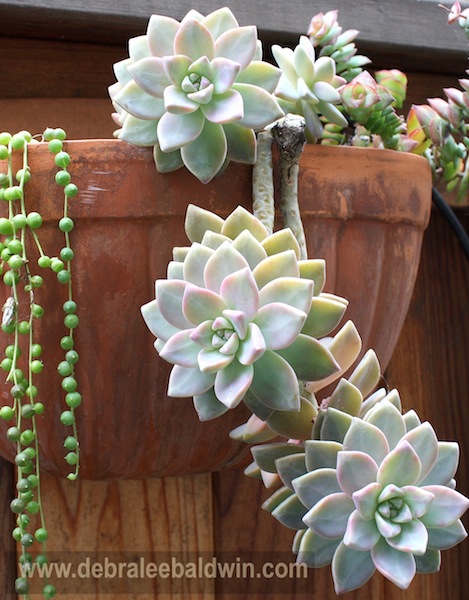
Here is a lovely ghost plant picture from the queen of succulents, Debra Lee Baldwin. Just look at those colors! Very excited about all my little ones!


Saturday, April 2, 2016

Agave Marginita - Time for a Trim

Ah, the agave. Favorite plant of city landscapers, likely due to the fact that it's nearly impossible to kill, will always make MORE agave to keep it company, and is so dangerous it keeps those ruffians off the street medians and freeway landscapes. The preferred agave is the Weber's Blue Agave which is the same agave used to make tequila, yay! However, the plant grows to be HUGE, boo! When it came time to get rid of my blue agave, the plant weighed about 175 pounds, and it wasn't nearly full grown. I couldn't do anything other than trim off the blade-like leaves to make it easier for the MEN to haul it out of the ground.
Weber's Blue Agave or agave tequilana at about 4-5 years old
There are nicer agaves to grow. One of two types of agaves I have held onto is the agave marginita. This agave is variegated with stripes of bluish-green, yellow, and white. It has some advantages over the agave tequilana:
  • The marginita does not send out long rhizomes, and nearly all "pups" (or baby plants) will grow right at its base.
  • It puts out very few pups, where an agave tequilana puts out dozens constantly (I rudely referred to mine as a slut)
  • It is smaller than the agave tequilana, and can be planted in tighter quarters.
  • It's more colorful than Weber's Blue
  • It doesn't form a huge body filled with liquid-heavy, tequila-production friendly pulp
Agave marginita in late 2013
My own agave marginita was purchased by my brother in the autumn of 2013. It was very small, perhaps 8" tall at the most. As it grew, it produced very few pups, and when I redesigned by garden, I was able to dig it out, move it, and replant it myself without the help of extra muscle. I'm going to guess that when it did that in 2015 it weighed about thirty pounds, max.
Agave marginita in the summer of 2015

I decided to make it a focal piece in the new design, surrounding it with aeoniums. At least, it WOULD be surrounded by the aeoniums, once they bred a bit more and I separated and spread them out. The plant had grown into a lovely, wavy thing that reminded me of undersea kelp, and since I was going for the tidal pool look (a VERY popular succulent-garden design) the plant was perfect.

Nearly a year later and some things had changed. The aeoniums quickly grew and filled in the space around the plant with the exception of where the large Mexican feather grass bush grew. The agave itself grew in and on top of the aeoniums, and I decided that now was the time to trim it. The feather grass bush had given me MANY offspring bushes, and I pulled the original plant (which a neighborhood cat had decided to make into a toilet). This left a C-shape of aeoniums around the agave with some clear soil room for me to do some trimming.

Pups are growing, a tiny one on the right and a couple of larger ones on the left.

There were two tasks to be completed when it came to trimming the plant. First, I had to remove crowded, older leaves that had grown too close to the other plants and the soil. Next, I had to remove any pups that were growing off the mother plant. The feather grass bush had been so large it left a very nice-sized opening for me to work with.
My preferred blade for agave trimming.

To do this trimming, you will want a very sharp knife with a long blade, at least three to four inches. A box-cutter will not be long enough and you'll have to make slice after slice and saw through the leaf, which is about 3 inches thick at the base. A sharp blade will slice cleanly through, while a dull blade will get caught on the extremely tough fibrous tissue the plant is made of. Keep in mind that you are working among other large leaves, all of which have thorns on their edges, so you want a took that works well, fast, and requires the least amount of movement on your part!

 When I had finished, there were about 8-10 cut leaves and four pup plants that had been cut off. Most of the pups were not viable as individual plants because I had carelessly sliced through them without getting some of the rhizome/root.

After trimming. Those aeoniums really filled in!

 I could have trimmed off more leaves, but I like the plants to look full. In another year I'll have to trim around the plant again, removing those leaves closest to the ground, by which time it will have produced new ones from the center to take their place. At this point, I'm going to be separating, rooting and planting the aeoniums in order to complete a full circle around the agave.

Viable pup has roots growing separately from the slashed-through rhizome.
There was one viable pup that I decided to keep alive. I really do love how this plant looks. My father helped me remove the largest of the blue agave's offspring, and I put this little guy in its place. The patch at the top of my drive is the LAST part of the garden to be gotten in order, and I've decided to do succulents there as well.
The removed agave tequilana is probably about two years old.


Aw, it looks just like its mother plant did when we planted her!


Friday, April 1, 2016

Deadheading: It's Not As Bad As It Sounds

There comes a time in most succulent's lives where you're going to have to cut off their heads. Don't worry, it sounds a lot worse than it really is.

Grew under some portulaca, was reaching for the sun.
Most succulent plants look best without long stems. However, most succulents will grow extremely long stems the longer they are alive, which can look awkward. There are also conditions a plant may grow in which cause it to stretch when it should be dish-shaped, and dead-heading is great for these plants, too.

I used a dead stem to prop up the plant heads so they'll grow straight.
Today, I finally cut off the heads of my pink butterfly kalanchoes. This plant, which originally was one, is now three (I gave one to my mother), and the two remaining had stems nearly two feet long. The stems reached horizontally along the ground so the plants could get into the bright sunshine. Not very attractive, so, I cut them off.

The bottom of the stem is close to, but not touching the soil.
You want to use a very sharp knife, preferably as clean as possible. Once you've beheaded your plant, place it in a pot hovering JUST ABOVE some moist soil. This encourages the plant to grow roots to reach that soil. With this plant, the long "leaves" provide a prop to keep the stem from touching.

It usually takes a few weeks for the plant to grow new roots. Yes, you can just cut some heads off and stick them in the ground, but they won't necessarily root that way, and they may rot. For plants you really love, take it slow.


There's a tiny pink plantlet to the right of the pot!
The "leftovers" aren't necessarily useless, either. The rooted stem, once the head of the plant is removed, might begin growing small plantlets where leaves formerly grew, or even at the top where the "head" was removed. Since I had to cut the stem into more than one piece (it was THAT LONG), I threw them all in a pot together with the rooted bits to give them a chance to make some babies.


I don't know how this will turn out, but I'm hoping that at least the "heads" of the plants will root successfully, as they are some of my favorite. The little pink plantlets are just gorgeous, and unlike other mother-of-thousands plants, cannot grow into plants themselves.
The two rooted stems and the other cut pieces.
The Results!

Thursday, March 24, 2016

Mother-of-Thousands Part II, the Mistake.

Whoops. It had no plantlets when it was given to me. It seemed so harmless, but it would appear that my kalanchoe tubiflora is just as feculent as it's more common, mother-of-thousands cousin. Hopefully this version, called a chandelier plant, will have less plantlets simply because they grow on the tips of the "leaves" instead of along the sides of the entire.

I didn't even bother looking it up before planting it among the other succulents in the large front garden. It seems a shame to move it, and now I'm committed to having one of these propagating things in the ground. Maybe it'll be okay. Perhaps it's better to have to deal with offshoots than regular grassy weeds.

There are still alternatives if you want a mother-of-thousands but don't want to deal with plantlets growing around it. The pink butterfly kalanchoe produces beautiful pink plantlets that aren't actually plantlets. They don't grow on their own, and the plant itself can only be reproduced through cuttings. It's one of my favorites, and if you can find it, I highly recommend adding it to your succulent garden for its pop of pink color. After searching for one for a few years I was pleasantly surprised to find them in stock at my local Home Depot a couple of seasons ago, so it IS possible to get hold of.

Sunday, March 6, 2016

Mother of Thousands

 There is a type of kalanchoe I really wanted to grow, but my research indicated wouldn't be the wisest. Commonly known as "Mother of Thousands" the brylophyllum daigremontianum or kalanchoe daigremontiana (the plant has been classified under two different genera), is famous for its fecundity, which is a fun way of saying it makes lots of babies. It reproduces more than rabbits. It's worse than agave plants, though at least it isn't spiky and dangerous.

A shriveled, but still productive adult plant.

The way this weird plant reproduces is rather unique. Along its "leaves" (no more scientific jargon, let's just call them leaves) it grows tiny baby plants, making the entire plant look fringed with crochet like your grandma put on doilies.  These plants develop roots even while still attached to the "mother" plant, and fall off by gravity or with the brush of a hand.

Dead body of original plant, split into four stems. See all those fuzzy lateral roots?
I had the opportunity to grab one (literally, I stole it) that had come loose from the restaurant planter where I found it. It was tiny, and dying, its little roots exposed and dried out. I figured, "Hell, I'll treat it better than this restaurant is," which as it turns out, was a complete lie. I put it in a large pot and after a couple of years pretty much forgot about it.

That's two years of barely any water, with me only occasionally giving it a spritz or the very seldom Southern California rain giving it a bath. In that time, it grew, and grew, and grew....

Decapitated heads of adult plant. Original plant was the size of one of the trimmed heads.
 It's amazing how much it grew. It even produced lateral roots on its stems, trying to get water from anything it could. The one thing that didn't happen so much was successful reproduction. See, if you don't water it, the babies can't grow.
 
I finally decided to give it another chance. I cut off the living tops of the plant, pulling out inches and inches of dried stem. In the above photo, the four heads are resting on the soil. Technically, when beheading and re-rooting a succulent, one should let the end callus and harden before putting it near soil, but I'm staying casual about this one. What I am letting grow is all the little babies. If the adult heads stay alive, great. If not, they definitely have descendants to take their place.

So, you might be wondering, why is this plant in a pot and not in the larger succulent garden? That fecundity again (isn't that a great word)! This plant is known to take over yards with its indiscriminate reproduction, and while I have space I'd like to fill, it's way too difficult to continuously pull these guys. It's worse than regular weeding. If you know anyone with this plant, you probably have seen the effects. It creates its own forest.

Mostly the kalanchoe, but at this point clover weeds remain snuck in there until the babies mature.
El NiƱo has been a bit disappointment for Southern California, but just a few days of rain in the last month have re-invigorated the growth of dropped baby plants. They are free to grow, with me actually keeping the pot free of invasive weeds this time.
Freshly fallen plantlets.

There's a couple of weeds in the center, but you can see the more mature babies actually developing into plants here.
 And so, it grows. I don't even know how many little guys are alive in that pot, though I'm sure it's well over 100 plants. Probably at least twice as many. If I keep out the weeds, they should grow into lovely little plants I can fob off as gifts for people I secretly hate. Just kidding. Maybe not kidding.