Showing posts with label plants. Show all posts

Monday, June 6, 2016

Propogating Plantlets En Mass

It's been AWHILE since my last entry, for the purely simple reason that my gardening time has been taken up by my non-succulent plants! I think I will cave and post all gardening stuff up here. I'm just doing too well with the dahlias!

This photo spread is a look at the "nursery" I set up in my mini-greenhouse. Some of the plants are cuttings, some are plants developing from dropped leaves, and some are just little plants, like my baby butterfly kalanchoes that grew on the leftovers from my deadheading of the pink plants.

Wanted to show the spray bottle, because I've found it's by far the BEST way to water plantlets and small cuttings. I got the spray bottle at Daiso Japan, my favorite "dollar" store (most items are actually $1.50). I set it to mist and then I mist the hell out of the plants. I want it looking like a Stephen King flick, at least for a millisecond. I'm done when everybody's all shiny and the soil is dark.

Most of these little guys are what I call "self-starters" or "accidental" propagation. Once a month, or just when I'm weeding, I look for dropped leaves that have started to grow into plants. Some succulents are so delicate the leaves just drop off when you brush them, so it's careful work to reach in and pick out the leaf with its plantlet and pink roots. I gotta be totally honest. I was at my parents' this weekend. I went through some of my mom's pots and stole her self-starters! Only five... besides, she container-gardens. No room for the plants to expand. I'm giving them life! Wink, wink. Emoji needed here.

If you take a look at this particular photo, you'll see that to the far right and center left are TWO BABY BUTTERFLY KALANCHOE PLANTS! These guys came from the leftover stems I had stuck in the dirt! They grew without leaves, so I popped them off their stems and after giving them a day or so to callous, set them in this wet, enriched soil. Weird thing; I've got three of the baby butterflies in here right now, and only the smallest one has developed roots at this point.

The aeonium above is the popular canariense variety, and is the last of about five cuttings I took the last time I "reorganized" that plot of plants. The other cuttings grew roots splendidly and have been popped in the ground with the rest of the succulent patch. Amazing to think they were cut off of plants that I bought originally at the size of the tiny cutting!

Sometimes you get strange growth. At the bottom center of the photo is a fuzzy little guy from my OTHER awesome kalanchoe, the fang plant. It's grown roots, but it doesn't seem to be developing a plant. It happens. Since it already has roots, I'm giving it a chance to turn into a "real" plant. This photo mostly contains ghost plant, jelly bean, and Fred Ives.

The Fred Ives plant has blown my mind. I bought one plant three years ago, and now I have at least ten fully-grown offshoot plants! An example of it is the orange-green rosette looking sideways at the center right. Fred Ives are one of those rainbow varieties, and while they aren't my FAVORITE, they are great to keep putting around the patch! Their plantlets grow REALLY weird, and always look wavy and wrong when tiny. I have two in my doll head pots right now. The other doll head has a ghost plant baby.

My original Fred Ives echeveria.
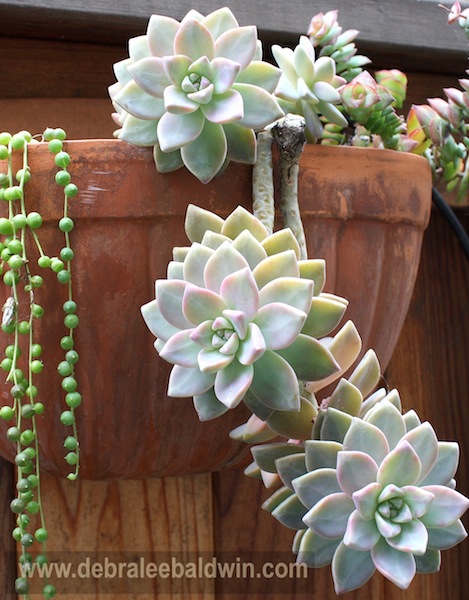
Here is a lovely ghost plant picture from the queen of succulents, Debra Lee Baldwin. Just look at those colors! Very excited about all my little ones!


Friday, April 8, 2016

Mother of Thousands: The Saga Continues

There was one patch of soil on my property that hadn't been cultivated. This was a strange rectangular piece at the top of the driveway. It often strikes me that my property has way too much space for plants and not enough space for the actual house itself. I also had the job of potting the mother of thousands tubiflora plant I had been given and ignorantly put into the actual ground.
I put about twelve plants in a smaller pot inside my house, these are the rest of the offspring.

The first job was to plant the remaining mother of thousands baby plants into a pot that coordinated a little more with the house. I stuffed all of the plants into a large blue pot, and I'm already thinking I should have just dragged the huge, white pot they were in out to the front and kept them there. This pot won't be large enough for very long. The bright-green plants will turn the same beige and pink shade as the other plant.


The tubiflora version has already grown much larger than I anticipated and will need a larger pot.
Second, I uprooted the tubiflora and planted it in another dark blue pot I had. This plant has already grown enough so that I can easily see I'm going to have to put it in a much larger pot. Sigh. Oh well, at least I've moved it from the direct soil.


Now at the top of the drive I have two baby agave marginitas and two pots of slightly-different mother of thousands plants. The passion-flower that covers the wall, as you can see, is actually a very small part of the entire plot, and I have one more area to put an agave or another similarly large succulent. Since I have extra ground cover from the planters in back, I'm going to cover the soil with with it. Since I also have extra lining from putting rocks down, I think I'll prep for weeds by laying that down first.

Sunday, April 3, 2016

Closing the Circle (no, this is not a Wiccan thing)

Aeonium rosettes cut cleanly from the mother plant.
This morning I did a little plant trimming and moving to complete the circle of aeoniums around my agave marginita. I started by cutting aeonium rosettes, then found that I had a smaller plant I could pull out and replant, as well as a rosette that had rooted.
This plant could be pulled out of the circle without leaving a large gap.

This little guy had already formed its own roots, so was a perfect choice.


In the larger plant I pulled, you can see how the long, brown stem would stand out as rather ugly in less dense foliage. This is a reason to deadhead a plant, and you would cut the stem off cleanly as closely to the "head" as possible.

Closing the gap. You can see I left some space for the agave where I had trimmed off leaves.
 I dug holes and planted the two rooted plants in the gap where the Mexican feather grass bush had been. They nearly enclose the space as is, but in less than a year will be dense enough with new growth to complete an entire circle around the agave.
Planted and watered.

After I planted the rooted plants, I got lazy. Because the aeoniums grow so prolifically, I wasn't too worried about coddling the two cuttings I had made. I set them in place lightly on top of the soil after I watered it for the rooted plants. Hopefully, without too much intervention from me, they will naturally callus and create a root system for themselves. It's worked before; these aeoniums are tough suckers!

Cuttings placed lightly balanced on the other plants so they won't touch soil directly.
The small plant in front/in back of the agave and aeoniums needs me to do some research on it (it was a gift), but I'm hoping it will be a small tree.

Saturday, April 2, 2016

Agave Marginita - Time for a Trim

Ah, the agave. Favorite plant of city landscapers, likely due to the fact that it's nearly impossible to kill, will always make MORE agave to keep it company, and is so dangerous it keeps those ruffians off the street medians and freeway landscapes. The preferred agave is the Weber's Blue Agave which is the same agave used to make tequila, yay! However, the plant grows to be HUGE, boo! When it came time to get rid of my blue agave, the plant weighed about 175 pounds, and it wasn't nearly full grown. I couldn't do anything other than trim off the blade-like leaves to make it easier for the MEN to haul it out of the ground.
Weber's Blue Agave or agave tequilana at about 4-5 years old
There are nicer agaves to grow. One of two types of agaves I have held onto is the agave marginita. This agave is variegated with stripes of bluish-green, yellow, and white. It has some advantages over the agave tequilana:
  • The marginita does not send out long rhizomes, and nearly all "pups" (or baby plants) will grow right at its base.
  • It puts out very few pups, where an agave tequilana puts out dozens constantly (I rudely referred to mine as a slut)
  • It is smaller than the agave tequilana, and can be planted in tighter quarters.
  • It's more colorful than Weber's Blue
  • It doesn't form a huge body filled with liquid-heavy, tequila-production friendly pulp
Agave marginita in late 2013
My own agave marginita was purchased by my brother in the autumn of 2013. It was very small, perhaps 8" tall at the most. As it grew, it produced very few pups, and when I redesigned by garden, I was able to dig it out, move it, and replant it myself without the help of extra muscle. I'm going to guess that when it did that in 2015 it weighed about thirty pounds, max.
Agave marginita in the summer of 2015

I decided to make it a focal piece in the new design, surrounding it with aeoniums. At least, it WOULD be surrounded by the aeoniums, once they bred a bit more and I separated and spread them out. The plant had grown into a lovely, wavy thing that reminded me of undersea kelp, and since I was going for the tidal pool look (a VERY popular succulent-garden design) the plant was perfect.

Nearly a year later and some things had changed. The aeoniums quickly grew and filled in the space around the plant with the exception of where the large Mexican feather grass bush grew. The agave itself grew in and on top of the aeoniums, and I decided that now was the time to trim it. The feather grass bush had given me MANY offspring bushes, and I pulled the original plant (which a neighborhood cat had decided to make into a toilet). This left a C-shape of aeoniums around the agave with some clear soil room for me to do some trimming.

Pups are growing, a tiny one on the right and a couple of larger ones on the left.

There were two tasks to be completed when it came to trimming the plant. First, I had to remove crowded, older leaves that had grown too close to the other plants and the soil. Next, I had to remove any pups that were growing off the mother plant. The feather grass bush had been so large it left a very nice-sized opening for me to work with.
My preferred blade for agave trimming.

To do this trimming, you will want a very sharp knife with a long blade, at least three to four inches. A box-cutter will not be long enough and you'll have to make slice after slice and saw through the leaf, which is about 3 inches thick at the base. A sharp blade will slice cleanly through, while a dull blade will get caught on the extremely tough fibrous tissue the plant is made of. Keep in mind that you are working among other large leaves, all of which have thorns on their edges, so you want a took that works well, fast, and requires the least amount of movement on your part!

 When I had finished, there were about 8-10 cut leaves and four pup plants that had been cut off. Most of the pups were not viable as individual plants because I had carelessly sliced through them without getting some of the rhizome/root.

After trimming. Those aeoniums really filled in!

 I could have trimmed off more leaves, but I like the plants to look full. In another year I'll have to trim around the plant again, removing those leaves closest to the ground, by which time it will have produced new ones from the center to take their place. At this point, I'm going to be separating, rooting and planting the aeoniums in order to complete a full circle around the agave.

Viable pup has roots growing separately from the slashed-through rhizome.
There was one viable pup that I decided to keep alive. I really do love how this plant looks. My father helped me remove the largest of the blue agave's offspring, and I put this little guy in its place. The patch at the top of my drive is the LAST part of the garden to be gotten in order, and I've decided to do succulents there as well.
The removed agave tequilana is probably about two years old.


Aw, it looks just like its mother plant did when we planted her!


Wednesday, March 30, 2016

Yog Sothoth Flowers and Spreads


My once-tiny purchase off of Ebay is now so huge it's falling apart under its own weight! It's been an amazing haven for snails, which I've harvested for the turtles that now live in my backyard. Today I pulled bits off and moved them to other parts of the garden to fill in space by becoming monsters themselves.

It's blooming!
It's also started blooming! It hasn't bloomed in the years I've had it, just grown and grown and grown. This type of succulent doesn't die after blooming, it's rather like what most people call a "jade plant."

If I'm lucky there will be half a dozen giant mutant plants in my succulent collection, glorifying and frightening my front yard! I'm guessing these plants are an acquired taste, but I've always been a fan of the strange and bizarre.
First flowers ever!


The stems grow in twists or fan-shapes.

The plant, weighed down, grows roots that anchor it to the ground.

Here, a section of more "normal" plant grows long stems weaving through other plants.

A crest that became too heavy to stay up. Now it will be a new plant.

Another heavy crest, this one will hopefully perk up a bit once it roots.
A third crest, similar to the first. I think of this shape as blades.

One of the original cuttings, now a little fan on its own.
The oldest original cutting has grown to be over a foot tall and going on two feet wide.

Monday, March 14, 2016

Get Yourself Some Gloves!

There is nothing fulfilling about squishing your hands through dirt and scratchy plants, and then coming inside from your gardening day with crescents of black under your fingernails and dirty wounds on your hands. Unless, of course, you're into that sort of thing. If you're like me, and at the very least have tired of nail brushes, gardening gloves are for you.

There are different types of gloves, from the cheap ones you can pick up at the Dollar Tree or Daiso, to expansive and expensive leather gloves from "fine retailers." It really comes down to what you garden and HOW you garden.

My three-year-old rose gloves with their holy fingers.
 I bought rose gloves with gauntlets in 2013 to protect my hands and lower arms when gardening my succulents (yes, they came in handy with the couple of rose bushes I have, too). When trimming an agave, or when doing ANYTHING with a euphorbia, the long gauntlet pieces are invaluable for protecting skin from serious thorn damage and sap burns. After three years (which is pretty impressive, considering how I treated them) my rose gloves were a mess and had little holes at the fingertips.

It was black crescent nails all over again, so I did some research and looked at my gardening habits before purchasing new gloves. I ended up with:

The elegant lady's choice...
1) A brand-new pair of my favorite rose gloves. Really, the leather gauntlets are amazing, there's great flexibility in the fingers, and they were quite a reasonable price at Amazon.

You can pretend you're Wolverine! Well... sort of.
2) A pair of rather ugly "Honey Badger" gardening gloves which only make me feel slightly like Freddy Krueger. Why the ugly? They come in a plethora of colors, but of course, I went for the cheapest ones. You have the option of choosing either hand for the "claws" or even both hands, but I went with the left as I'm right-handed. They were a fantastic choice and will ensure the life of my precious gauntlet gloves by doing the dirt-related stuff the gauntlets weren't meant for.

The plastic claws on the gloves are PERFECT for digging into the dirt. I've been using them while upgrading my backyard planter in preparation for some hand-me-down box turtles I'm receiving next week. I can easily pull the ground cover back from the actual soil in order to plant new plants, or to install the water and feeding dishes.

Depending on my purpose, I will wear either set of gloves. For above-the-dirt work, like trimming or staking plants, or snail-hunting for my future turtles, the rose gauntlets. For weeding and planting, the badger gloves. Gloves are great no matter what you use, but from experience I recommend buying leather or plastic, as woven-fabric gloves leave tiny holes for dangerous sap to sink in through.

Sunday, March 13, 2016

Plumeria Dormancy - No, Your Plant's Not Dead!


There are so many varieties of succulent plants that it's often a surprise to learn that a plant IS a succulent. At least, that was my reaction on finally learning that the plumeria, native to Hawaii and beloved of gardeners in temperate through tropic zones, is, of course, a succulent plant.

It should have been obvious. The plumeria has thick, fleshy stems that hold large amounts of water. It can be propagated rather easily through cuttings (all the plumerias I own are the result of cuttings bought in Hawaii back in 1997). Of COURSE it's a succulent, which is an excellent excuse for me to write a blog entry on one of the strangest issues one deals with when it comes to the plumeria.

Black, shriveled baby leaves are a sign of dormancy.
I thought I had killed my plumerias when they all dropped their leaves and seemed unable to grow new ones, but as it turns out I hadn't. Plumerias go through a period of dormancy in most climates, and in Southern California this dormancy period is roughly the whole of winter. For at least four-five months, the plants will not grow new leaves, and in fact, any little leaves that begin to grow will turn into shriveled black wastes that drop off at a touch.
To double-check for dormancy, brush or dig away dirt at the base of the plant. A woody, tough, and dry stem indicates the plant is keeping new water out, and is an indication to stop watering it.

What do you do when this happens? NOTHING! Don't do anything, except perhaps sweep up those shed adult leaves. When your plumeria goes dormant, you STOP WATERING. You can easily kill your plant during its dormancy by watering it. Just STOP. Leave the plant alone, but keep an eye on it as winter turns into spring.

My most mature plumeria is still dormant.
Not all plumeria plants, even those in the same location, will come out of dormancy at the same time. I've noticed that in the case of the three small trees I own, the least-developed seem to come out of dormancy faster than the larger, more mature trees. If you have a drip system like I do, the easiest thing is to divert the hose that leads to the still-dormant plant, then simply replace it next to the tree once it starts growing leaves again.
My second-oldest plumeria seems to be giving me a very immature gesture.

When the plant begins to grow leaves that stay alive, and more importantly, mature into true leaves, you can return to watering. So, it's really very simple. When your plumeria drops all of its leaves, stop watering. Months later, when it starts to grow them again, go back to watering. In the California drought I haven't had to worry about extra rainfalls overwhelming dormant plans with water, but if you live in an area with constant rainfall, you might want to do what neighbors of mine have done and keep your plumerias in pots on wheeled bases.

My youngest plumeria was the first to start making leaves again.
If you want to plant your plumeria in the ground, I say go for it. A neighbor from my childhood still has a giant plumeria that has been in the ground for about forty years. It's absolutely huge and has survived several rainy seasons. Also, remember, Hawaii, where the plants come from, stays moist all year round (and thus plants there have a shorter dormancy period).

So, don't fret. You aren't a plant murderer! Your amazing tropical succulents have just "gone to sleep" for a bit, like hibernating mammals. When the weather warms up, keep your eye on them for new leaves and resume watering. It's that simple.